
About CVD Diamond
Carbon has three known allotropes: diamond, graphite and fullerene.
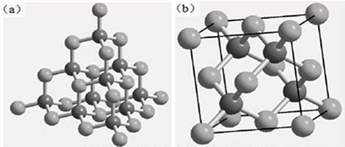
Every carbon atom in a diamond crystal forms a covalent bond with four other adjacent carbon atoms in an sp3 hybrid orbital. Every four adjacent carbon atoms form a regular tetrahedron (a), forming an infinite three-dimensional network. Four regular tetrahedrons form a unit cell, and the crystal type is face-centered cubic (b). The C-C bond in diamond is very strong, all valence electrons participate in the formation of covalent bonds, and there are no free electrons, so diamond is very hard, non-conductive, and has a melting point of 3800°C. The ignition point of diamond in pure oxygen is 720-800°C, and in air it is 850-1000°C. It is insoluble in any acid and alkali at room temperature, is not resistant to oxygen-containing acid salts and strong alkalis at high temperatures, and reacts chemically with metals such as iron, cobalt, nickel, manganese and platinum at a certain temperature.
CVD (Chemical Vapor Deposition) diamond is a mixture of carbon-containing gas and hydrogen that is excited and decomposed at high temperature and pressure below standard atmospheric pressure to form active diamond carbon atoms, and deposits inter-grown polycrystalline diamond on the substrate (or controls the deposition growth conditions to deposit and grow diamond single crystals or quasi-single crystals).
Since CVD diamond does not contain any metal catalyst, its thermal stability is close to that of natural diamond. CVD diamond grains are disordered and have no brittle cleavage planes, so they are isotropic.
(1) The main properties of CVD diamond:
| Property | CVD Diamond | Natural Diamond | Other Materials (e.g., PCD, SiC) |
|---|---|---|---|
| Thermal Conductivity | 1000–2200 W/m·K | 2200 W/m·K | PCD: 400–700 W/m·K; SiC: ~120 W/m·K |
| Hardness (Vickers) | ~10,000 HV | ~10,000 HV | PCD: 6000–8000 HV; SiC: ~2500 HV |
| Young’s Modulus | 1050–1200 GPa | ~1050 GPa | PCD: ~900 GPa; SiC: ~410 GPa |
| Thermal Expansion | 0.8–1.2 × 10⁻⁶ /K | ~1.0 × 10⁻⁶ /K | PCD: 2–3 × 10⁻⁶ /K; SiC: ~4.0 × 10⁻⁶ /K |
| Density | ~3.52 g/cm³ | ~3.52 g/cm³ | PCD: ~3.5 g/cm³; SiC: ~3.2 g/cm³ |
| Bandgap | 5.5 eV | 5.5 eV | SiC: ~3.3 eV; GaN: ~3.4 eV |
| Surface Roughness (Polished) | < 1 nm | < 1 nm | PCD: >10 nm; SiC: 5–50 nm |
| Optical Transparency | Transparent (UV–IR) | Transparent (UV–IR) | PCD: Opaque; SiC: Translucent |
| Isotopic Purity Available | Yes (e.g., 12C-enriched diamond) | No | Not applicable |
| Custom Geometry | Easily tailored via MPCVD | Limited by natural crystal growth | PCD: Possible by sintering |
| Impurity Level | Ultra-low (ppb level achievable) | Contains nitrogen, boron, etc. | Higher impurity levels |
| Application Versatility | Electronics, optics, thermal sinks | Mainly jewelry, limited industrial | Cutting tools, thermal, optics |
Due to its numerous excellent properties, CVD diamond has an irreplaceable role and broad application prospects in fields such as mechanics, microelectronics, thermal engineering, optics, aerospace, military engineering, and medicine.
(2) DC Arc Plasma Jet Method for CVD Diamond Production:
Currently, CVD diamond production methods include the hot filament method, microwave plasma method, DC hot cathode method, and DC arc plasma method. The DC plasma method excels over the other methods due to its fast growth rate and relatively high purity of diamond films. The basic principle of DC plasma diamond film production is shown in Figure (c).
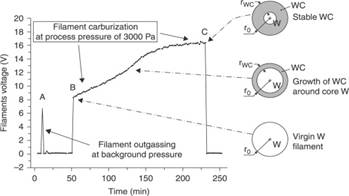
(A) Hot Filament CVD
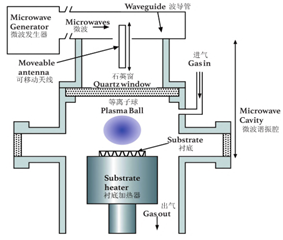
(B) MPCVD
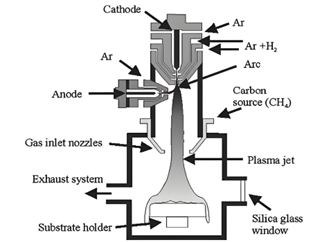
(C) DC ARC CVD