
January 4th 2026
In an era where environmental sustainability and regulatory compliance are paramount, wastewater treatment technologies must deliver high pollutant removal efficiency while minimizing operational costs and secondary pollution. Among the most promising innovations in this field are Boron-Doped Diamond (BDD) electrodes—an advanced electrochemical solution that is redefining how industries tackle challenging wastewater streams. This article explores the science, advantages, and real-world performance of BDD electrodes compared with traditional materials, supported by recent data and case insights.
What Are BDD Electrodes?
Boron-Doped Diamond electrodes are specialized electrochemical anodes produced by incorporating boron atoms into a diamond film grown on conductive substrates like titanium or niobium. While pure diamond is an electrical insulator with a very wide bandgap (~5 eV), the introduction of boron converts it into a p-type semiconductor with sufficient conductivity for electrochemical applications. This unique combination of diamond’s sp³ structure and boron-induced conductivity endows BDD electrodes with exceptional stability and performance for oxidation processes in water treatment.
How BDD Electrodes Work in Wastewater Treatment
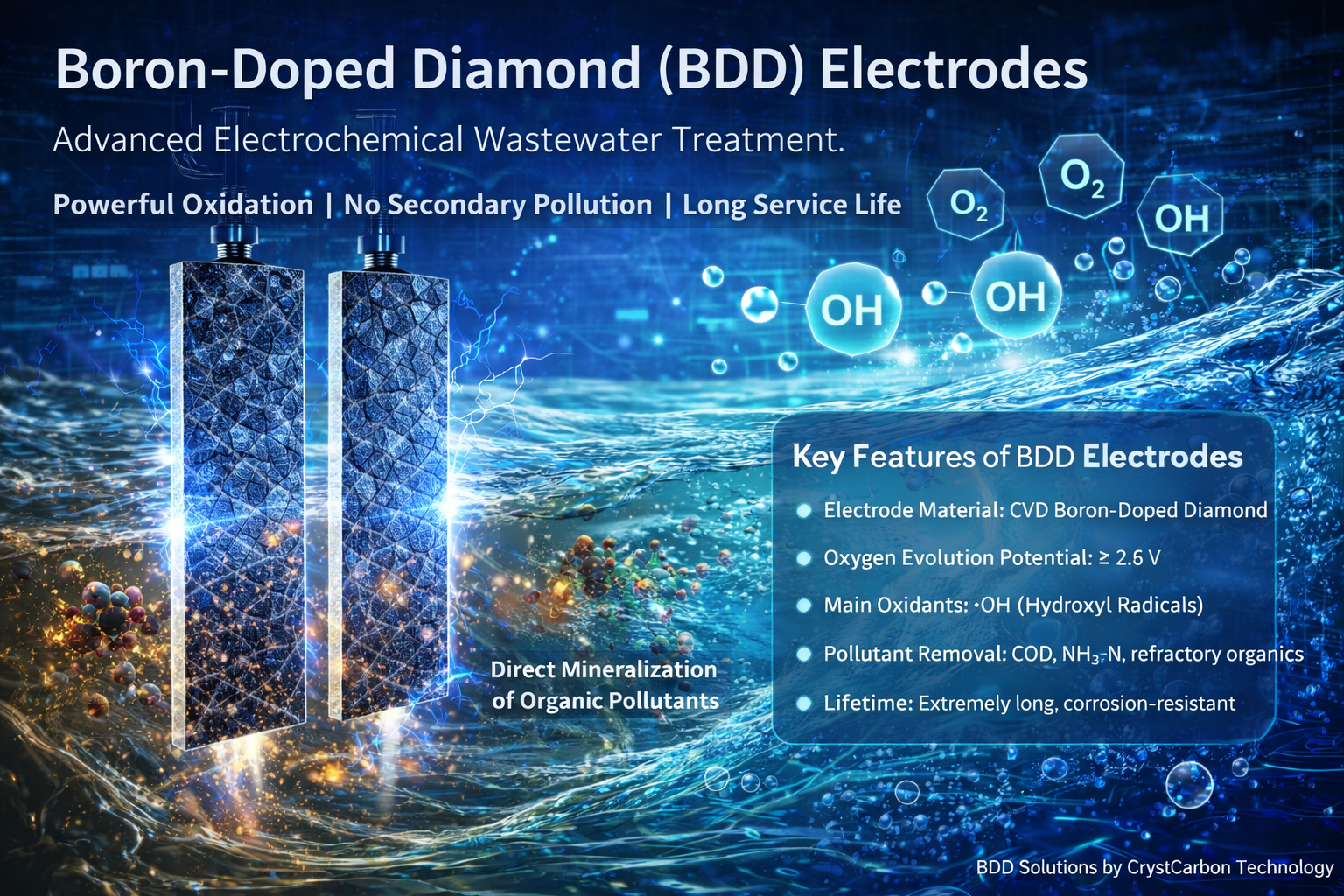
The fundamental mechanism by which BDD electrodes clean water is electrochemical advanced oxidation (EAOP). When current is applied, BDD electrodes generate highly reactive hydroxyl radicals (•OH) directly on their surface due to their ultra-high oxygen evolution potential (OEP). These radicals are among the most powerful oxidants in aqueous electrochemistry, enabling the non-selective and complete mineralization of organic pollutants—including those considered refractory or difficult to treat.
Here’s how BDD works in practice:
- Direct oxidation: Pollutants are oxidized at the electrode surface.
- Indirect oxidation: Generated •OH radicals react with contaminants in the bulk solution.
- Final products are often harmless substances like CO₂, H₂O, and inorganic ions.
Importantly, BDD electrolysis relies solely on electrical energy, eliminating the need for hazardous chemicals and reducing secondary pollution risks compared with conventional chemical oxidation methods.
Advantages of BDD Electrodes Over Traditional Materials
1. Much Higher Oxidation Potential
The oxygen evolution potential is a key metric that determines how effectively an electrode can generate oxidizing radicals before unwanted side reactions—like oxygen evolution—dominate. BDD electrodes exhibit OEP values of 2.2–2.6 V (vs. SHE), significantly higher than traditional graphite, platinum, and mixed metal oxide (MMO) electrodes.
| Electrode Material | Oxygen Evolution Potential (V vs. SHE) |
|---|---|
| Platinum (Pt) | ~1.6–1.9 |
| RuO₂ | ~1.4–1.7 |
| SnO₂ | ~1.9–2.2 |
| BDD | 2.2–2.6 |
This wider potential window enables BDD electrodes to produce more •OH radicals, improving oxidation efficiency and pollutant degradation capability compared with conventional materials that plateau at lower potentials.
2. Broad Pollutant Removal and High Efficiency
BDD electrodes are effective against a wide range of contaminants, including organic compounds, refractory chemicals, pharmaceuticals, and even emerging pollutants like PFAS (per- and polyfluoroalkyl substances):
- In experimental studies, BDD electrolysis achieved >99.8 % removal of BPA (bisphenol A) from landfill leachate within just a few hours. MDPI
- For PFAS degradation, BDD systems have shown up to ~99 % removal of certain PFAS compounds within short treatment times (<90 min). Water and Wastewater
These results far exceed what is typically achievable with conventional electrodes or biological treatment alone, especially for recalcitrant organics and micropollutants.
3. Strong Stability, Corrosion Resistance, and Longevity
Unlike many metal or carbon electrodes that degrade, corrode, or foul over time, BDD electrodes demonstrate exceptional chemical and electrochemical stability:
- They maintain structural integrity across wide pH ranges (pH 1–11) without significant performance loss.
- Their non-adsorptive diamond surface resists fouling and “poisoning,” ensuring consistent activity over extended operation.
- As a result, BDD electrodes often require less frequent replacement and lower maintenance compared with traditional anode materials, reducing operating costs in the long run.
This durability makes BDD particularly attractive for industrial wastewater applications, where harsh chemical environments are common.
4. Greater Adaptability to Variable Water Quality
Traditional wastewater treatments—like Fenton oxidation or biological digesters—are sensitive to influent fluctuations. For example, Fenton processes only operate efficiently in narrow pH ranges (typically ~3–5) and generate sludge that needs further handling. BDD electrolysis, in contrast:
- Adapts easily to changing water quality.
- Maintains performance even when contaminant levels vary widely.
- Works efficiently with real industrial wastewater, not just ideal lab solutions.
This adaptability means facilities can operate consistently without frequent chemical dosing adjustments or pH control.
5. Reduced Secondary Pollution and Safety Benefits
Because BDD electrodes rely on electrochemical reactions rather than external chemical oxidants, the process significantly lowers the risk of secondary pollution from reagents or by-products. Traditional oxidation processes often require hydrogen peroxide, chlorine, or other additives that can pose handling risks and generate additional waste streams.
In contrast, BDD electrolysis uses electricity as the sole driver, making it inherently safer and more environmentally compatible—especially for facilities aiming to minimize chemical inventories or comply with strict safety standards.
Comparisons with Other Technologies
BDD vs. Mixed Metal Oxide (MMO) Electrodes
Electric current studies show that BDD electrodes require less energy per unit of COD removed than MMO systems—reported as roughly 4.3 × 10³ kWh per kg COD. This translates into lower power costs for equivalent pollutant removal.
BDD vs. Biological Treatment
While biological processes are cost-effective for biodegradable organics, they struggle with toxic, stable, or synthetically derived micropollutants. BDD handles both biodegradable and non-biodegradable compounds, providing a single, unified solution without the need for multiple processing stages.
Real-World Industrial Applications
BDD electrode technology has been successfully applied in sectors with stringent wastewater challenges:
- Petrochemical wastewater: Effective reduction of COD and color, breaking down complex refractory organics.
- Dye and textile wastewater: Capable of treating high concentrations of dyes and auxiliary chemicals.
- Pharmaceutical effluents: Demonstrated degradation of drug residues and antibiotic compounds, sometimes in conjunction with nanofiltration for enhanced performance. 科学直通车
- PFAS removal: High removal efficiencies indicate promise for addressing one of today’s most challenging contaminants. Water and Wastewater
These cases highlight BDD’s versatility and effectiveness across a range of difficult wastewater streams.
Challenges and Considerations
Despite the clear advantages, BDD electrodes are not a universal panacea:
- Higher initial costs: The CVD process used to create high-quality diamond films is more expensive than producing conventional electrodes.
- Power demand: While efficient at oxidation, BDD systems still require electrical energy input, which must be balanced against cost and grid availability.
- Optimization requirements: Performance is influenced by current density, pH, and reactor design, meaning system engineering expertise is essential to achieve optimal results.
However, when total cost of ownership (including maintenance, chemical usage, and regulation compliance) is considered, many industrial users find BDD technology highly competitive.
Conclusion: BDD Electrodes—A Strategic Investment in Water Quality
As pollutants become more complex and discharge standards more stringent, wastewater treatment technologies must evolve. Boron-Doped Diamond electrodes provide a powerful, adaptable, and environmentally friendly solution, combining high oxidation potential, broad contaminant removal capability, and excellent chemical stability. Backed by performance data that shows superior removal rates, wider operational conditions, and lower long-term costs than many conventional techniques, BDD electrodes are rapidly becoming one of the most compelling advanced treatment options available today.
For industries seeking to meet both regulatory demands and sustainability goals, adopting BDD-based electrochemical oxidation systems represents a forward-looking investment in water quality and environmental stewardship.
Add comment